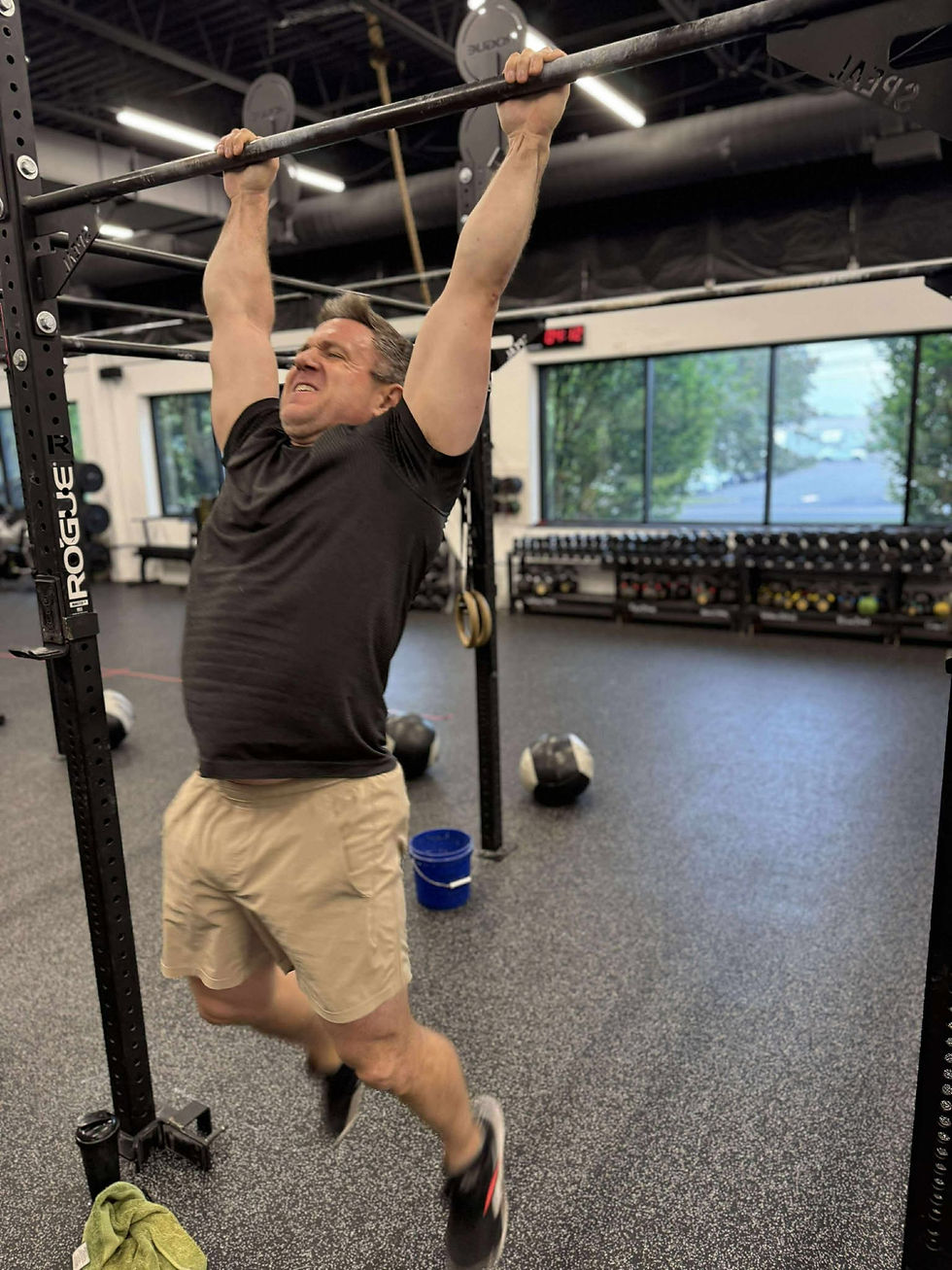
CrossFit 201 Guide To Your First Strict Pull-Up

It is one of the most iconic milestones in functional fitness. You can lift heavy barbells, you can sprint through burpees, and maybe you can even fly through kipping pull-ups.
But standing dead-still under the rig and pulling your chin over the bar using pure, unadulterated strength?
That hits different.
For many inhabitants of the planet earth, the strict pull-up feels like an elusive goal. But it isn't an elite skill reserved for a selct few. It is a milestone that can be acheived by anyone who wants to put in the targeted, consistent work.
Let's break down the anatomy of the movement, look at why biological differences make this tougher for women, and map out a practical blueprint to get you over the bar using our daily class structure.
The Anatomy of a Strict Pull-Up
To build a strict pull-up, you need to understand that it is a full-body compound movement. You aren't just using your arms; you are engaging an entire kinetic chain.
The Primary Movers
Latissimus Dorsi (The "Lats"): These are the large, wing-like muscles of your back. They do the heavy lifting to pull your upper arms down and back, driving your body upward.
Biceps Brachii and Brachialis: Your arm flexors. They assist the lats by bending the elbow to pull you that final few inches over the bar.
The Upper Back and Stabilizers
Rhomboids and Middle/Lower Trapezius: These muscles sit between and below your shoulder blades. They are responsible for scapular depression and retraction, pulling your shoulders down and away from your ears so your lats can actually do their job.
Rotator Cuff: A cluster of small muscles that stabilize the shoulder joint, ensuring the humeral head stays safely in its socket under load.
The Core and Grip
Forearm Flexors: If you can't hold onto the bar, you can't pull. Grip strength is often the hidden bottleneck.
Rectus Abdominis and Obliques: A strict pull-up requires a tight "hollow body" position. If your legs are swinging or your back is excessively arching, you are leaking force. Your core keeps your body moving as a single, rigid unit.
The "In-Class" Action Plan
You don't need to spend two hours after class doing extra bodybuilding routines to get a pull-up. The most effective way to build this strength is by utilizing our warm-ups, strength sessions, and metcon scales right here at CrossFit 201.
Here is the exact progression hierarchy to follow:
Phase 1: Building the Base (In the Warm-up) Before you can pull, you must learn to engage the shoulders. Use your 2-3 minutes on the rig during the daily warm-up for these two movements:
Active vs. Passive Dead Hangs: Hang from the bar completely relaxed (passive), then pull your shoulder blades down and back without bending your elbows (active). Hold for 3 seconds, release. Do 3 sets of 8.
Hollow Body Holds: On the floor, press your lower back into the ground, lift your legs and shoulders slightly. This is the exact shape you need to hold while hanging from the bar.
Phase 2: Horizontal Pulling (In Strength Cycles and Metcons) If you cannot pull your own body weight horizontally, you cannot do it vertically.
The Ring Row: Do not sleep on the ring row. To make it effective for strict pull-up strength, walk your feet forward until your body is nearly parallel to the floor. Pull with a tempo: 1 second up, a 1-second squeeze at the top, and a 3-second controlled lowering phase.
Phase 3: Vertical Progression (Metcon Scaling) When a workout calls for "pull-ups," resist the urge to just grab a heavy band and bounce around. Instead, choose scales that build eccentric and absolute strength:
Toe-Assisted Pull-Ups: Allows exact self-regulation of weight. Set a barbell on a rack at chest height. Sit underneath it, use your legs just enough to assist your upper body in pulling your chin over the bar. NOTE: Make sure you are on the opposite side of the rig from where the barbell is, or the bar, and you, will roll off. Stay safe!
Eccentric (Negative) Pull-Ups: The eccentric phase builds strength faster than the concentric phase. Use a box to jump your chin over the bar. Hold for 1 second, then take a full 5 seconds to lower yourself to a dead hang. NOTE: These are a very potent spice. Do NOT do too many of these. If you really fight to stay up, 10-15 of these over an entire hour class is more than enough to see progress. Too many negatives, especially in an un-trained athlete can damage your biceps and forearms. Ask a coach to help here.
Band-Resisted (With a Pause): Maintains the vertical pulling track. Use a band that allows you to hit a full range of motion, but focus on a 1-second strict pause with your chin clearly over the bar—no kipping allowed. NOTE: Same as with negatives, focus on quality over quantity. Bouncing these will reduce their effectiveness, but doing too many "strict" in a single workout can lead to injury. Check with your coaches on appropriate number for the workout.
Why Women Face a Harder Battle (And How to Win It)
It is a well-documented reality in any gym: female athletes often have to work significantly harder and longer to achieve their first strict pull-up than their male counterparts. This isn't a matter of effort or willpower; it comes down to biomechanics and physiology.
The Upper-Body Mass Disadvantage.
On average, women possess about 40% to 45% less upper-body muscle mass than men. Conversely, women naturally carry a higher percentage of lower-body mass. Because a pull-up requires you to lift 100% of your total body weight using only that upper-body mass, the relative strength demand is significantly higher for females.
Center of Mass and Levers A man's center of mass is typically higher (closer to the chest), while a woman’s center of mass is lower (closer to the pelvis). When hanging from a bar, a lower center of mass changes the leverage of the movement, requiring more core stabilization to prevent the lower body from acting as a dead-weight anchor.
The Good News While the mountain is steeper, the summit is completely reachable. Neuromuscular adaptations, teaching your brain to recruit the muscle fibers you do have more efficiently, can completely overcome these structural differences. It just requires a deliberate, structured plan.
The most common point of failure for women attempting a strict pull-up occurs right at the very bottom of the movement, specifically, the transition from the dead hang into the first few inches of the pull.
While many assume the "weak link" is simply arm strength or biceps, the true culprit is almost always a combination of two specific areas: scapular depression (the upper back stabilizers) and the deep latissimus dorsi connection.
Here is a breakdown of why this specific weak link fails and how it halts the movement before it even begins.
1. The Broken Link: Scapular Depression (The Lower Trapezius and Rhomboids)
To initiate a strict pull-up correctly, an athlete must first perform a "scapular pull-up." This means pulling the shoulder blades down and locking them onto the ribcage.
Most women struggle with overactive upper trapezii (the muscles around the neck and tops of the shoulders) and underactive lower/middle trapezii and rhomboids. When hanging from the bar, if these lower stabilizing muscles cannot fire to depress the scapula, the shoulders stay crammed up against the ears.
Without that solid scapular foundation, the body cannot mechanically leverage the lats. The movement becomes dead in the water because you cannot pull from an unstable shoulder joint.
2. The Biomechanical Disadvantage: The Bottom of the Lat Curve
Muscles are weakest when they are fully extended. At the bottom of a dead hang, the lats are at their maximum length. Because biological females generally possess less upper-body muscle mass to begin with, generating enough force to initiate a contraction from a completely stretched position is incredibly difficult.
When a male athlete hangs from a bar, his baseline muscle mass often allows him to power through that bottom position even with poor technique. A female athlete, however, requires near-perfect muscular recruitment to overcome that initial dead-weight inertia.
What This Looks Like in Real Time
When an athlete has this specific weak link, you will notice a distinct pattern:
The Shoulder Shrug: They hang from the bar and immediately bend their elbows to try to pull up, but their shoulders stay shrugged up by their ears. The elbows move, but the torso doesn't go anywhere.
The Core Break: Out of frustration, they will try to kick or arch their lower back excessively to create momentum, breaking the rigid "hollow body" line and leaking any force they had.
How to Fix the Weak Link
To bridge this specific gap, the focus needs to shift toward building strength at the very bottom range of motion:
Scapular Pull-Ups (with a Hold): Hang from the bar, pull the shoulder blades down and back without bending the elbows, and hold that active position for 3 to 5 seconds before lowering. This builds the mind-muscle connection and strength required to initiate the lift.
Dead-Stop Ring Rows: Set up for a heavy ring row, but let the shoulders completely protract at the bottom, then explicitly focus on pulling the shoulder blades together before bending the elbows to pull the chest to the rings.
Isolating the Bottom of the Negative: When doing negative pull-ups, instead of dropping quickly at the bottom, spend an extra 2 to 3 seconds strictly controlling the final two inches of the descent right before reaching the full dead hang.
Consistency is the Catalyst
The secret ingredient to a strict pull-up isn't a magical exercise; it is frequency. That holds for both male and female athletes. It also holds for someone who wants to increase the number of strict pull-ups they can perform in a given set.
Commit to spending just 5 minutes, three days a week, performing active hangs, slow negatives, or heavy ring rows before, during, or after class. Treat the movement with respect, focus on keeping your core completely braced without swinging, and let the compound adaptations take place.
CrossFit coaches are ALWAYS trying to help athletes improve their pull-up capabilities. But next time you are in class, let them know, "My goal is a strict pull-up." We will help you tailor that day's workout to ensure every rep you do is a stepping stone toward getting your chin over that bar. Let's get to work.